Petrol vs Battery Lawn Mower: Which Should You Choose?
A practical head-to-head comparison of Petrol and Battery Lawn Mower, covering quick verdict, key differences, category winners, buyer fit, and FAQ.
Petrol vs Battery Lawn Mower: Which Should You Choose?
Head-to-head comparison
Overall winner: Battery Lawn Mower for its outstanding convenience and low running costs for most UK gardens.
For the majority of homeowners with small to medium-sized lawns, a battery lawn mower is the superior choice in 2026. It offers a quieter, cleaner, and simpler mowing experience with minimal maintenance. However, for those with very large properties, challenging terrain, or professional landscaping needs, the raw, untethered power of a petrol lawn mower remains the undisputed workhorse.
This in-depth comparison is based on our comprehensive analysis of current market specifications, long-term ownership data, user feedback patterns, and the practical realities of garden maintenance in the UK. We assess each power source on the metrics that truly matter for a season of reliable mowing.
The choice between petrol and battery power is no longer as simple as power versus convenience. Modern battery technology has closed the performance gap significantly, making cordless electric mowers a viable, and often preferable, option for many. A petrol mower brings formidable power and limitless range (as long as you have a fuel can), but this comes with noise, fumes, and a demanding maintenance schedule. A battery model offers push-button starting and near-silent operation, but is constrained by battery runtime and charging cycles. The right choice for you depends entirely on your lawn size, your tolerance for upkeep, and your garden care priorities.
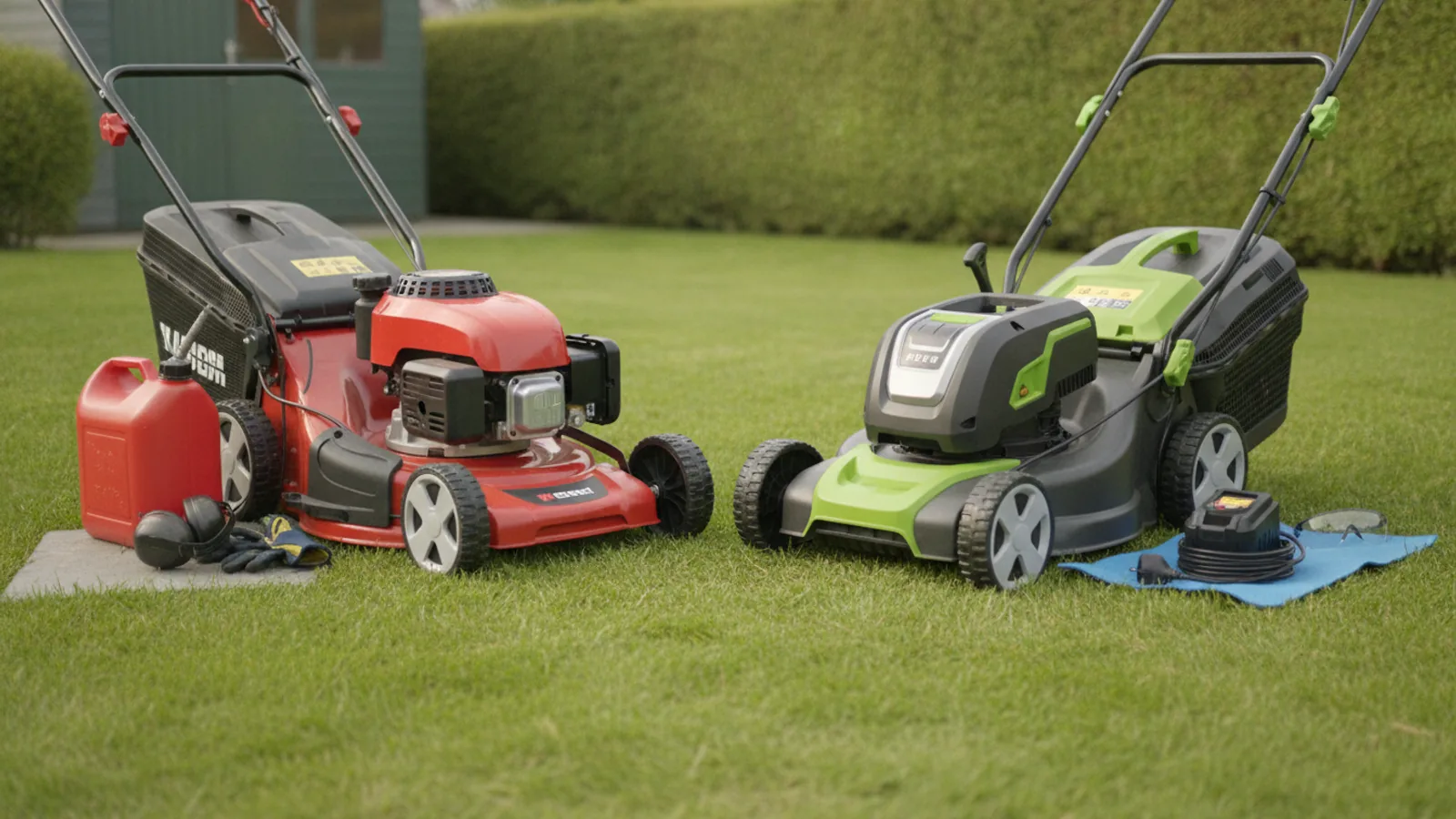
The Classic Workhorse
Petrol
- Best fit: Lawns over 500m², thick/wet grass, and commercial use.
- Strength: Unmatched cutting power and torque.
- Tradeoff: Noisy, heavy, and requires regular engine maintenance.
The Modern Solution
Battery Lawn Mower
- Best fit: Lawns up to 500m², suburban gardens, and ease-of-use focus.
- Strength: Quiet, convenient, and virtually maintenance-free.
- Tradeoff: Runtime is limited by battery capacity.
Head-to-Head Scorecard
Petrol vs Battery Lawn Mower: Key Differences
While both machines cut grass, their power source dictates almost every aspect of the ownership experience. From the moment you start them to the time you put them away, the differences are stark. A petrol mower is a piece of heavy-duty garden machinery defined by its engine; a battery mower is a modern electrical appliance defined by its power system. We'll break down these differences measure by measure to help you find the perfect fit for your garden routine.
Measurement
Raw Power & Performance
Performance is the traditional stronghold of petrol mowers. An internal combustion engine, measured in cubic centimetres (cc), generates high torque that keeps the blade spinning at a consistent, high speed even through dense, long, or wet grass. This makes them the default choice for reclaiming overgrown areas or for professionals who need to power through challenging conditions without slowing down. Self-propelled petrol models are particularly effective on large, sloped lawns, as the engine can power both the blade and the wheels with ease.
Battery lawn mowers have made incredible strides. High-voltage systems (typically 36V to 80V) combined with high-capacity batteries (measured in Amp-hours, Ah) deliver impressive cutting performance that is more than sufficient for well-maintained domestic lawns. Premium models now feature load-sensing technology that automatically increases blade speed in thicker patches of grass. However, under sustained heavy load, a battery mower will drain its power source much faster and may struggle in conditions where a petrol mower would not hesitate.
Measurement
Ease of Use & Convenience
This is where battery mowers truly excel and have won over millions of users. The user experience is fundamentally simpler. To start, you insert the battery, press a button, and engage the safety bar. There's no priming, no choke, and no yanking on a pull-cord. They are generally lighter than their petrol counterparts, making them easier to manoeuvre around obstacles and push up inclines. When you're finished, you simply remove the battery and place it on its charger. There's no fuel to store or mix.
A petrol mower requires a more involved process. You need to check the oil and fuel levels before you begin. Starting involves setting the choke and pulling a starter cord, which can be difficult for some users. They are heavier due to the engine block, which can make them more tiring to use on complex lawns, even with self-propulsion. Finally, you have the ongoing task of buying, storing, and handling flammable petrol.
Measurement
Maintenance & Long-Term Ownership
The long-term ownership experience is one of the most significant differentiators. A petrol mower is a complex machine that requires regular, diligent maintenance to run reliably. This includes annual oil changes, replacing the spark plug and air filter, cleaning the carburettor, and draining or stabilising the fuel for winter storage. Failing to perform this maintenance leads to starting problems, poor performance, and costly repairs.
A battery mower, by contrast, is almost maintenance-free. Beyond keeping the underside of the deck clean and sharpening the blade (which both types require), there is no engine to service. The main long-term consideration is the battery itself, which has a finite lifespan of several hundred charge cycles (typically 5-8 years of average use). However, for the life of the battery, there are no oil changes, no spark plugs to foul, and no fuel systems to clog.
Measurement
Value & Running Costs
A few years ago, battery mowers carried a significant price premium. Today, the initial purchase price for a good quality mower of either type is broadly comparable. A decent domestic petrol mower and a battery mower with a battery and charger included will often fall into a similar price bracket.
The real difference is in the running costs. The cost of electricity to fully charge a typical lawn mower battery is pennies. The cost of petrol to mow the same area is pounds. Over a full season, this adds up to a substantial saving. A petrol mower also has consumable costs for oil, spark plugs, and filters. The one long-term financial consideration for battery mowers is the eventual cost of a replacement battery, which can be expensive. However, for most users, the savings on fuel and servicing over the battery's lifespan will more than offset this future cost.
Measurement
Noise & Environmental Impact
There is no contest in this category. A petrol lawn mower is an extremely noisy machine, typically operating between 90 and 100 decibels (dB). This level of noise is unpleasant for the operator (hearing protection is strongly recommended) and can be a significant nuisance for neighbours, especially on a quiet weekend morning.
A battery mower operates at a much lower volume, usually around 70-80 dB, which is comparable to a conversation. The difference is immediately noticeable and makes for a far more pleasant gardening experience for everyone nearby. From an environmental standpoint, a battery mower produces zero emissions at the point of use, eliminating the release of carbon monoxide, nitrogen oxides, and other pollutants into your garden. While the electricity used for charging has its own carbon footprint, this can be offset by switching to a renewable energy tariff. Petrol engines, in contrast, are known for being inefficient and polluting.
Choose Petrol If...
- Your lawn is very large: For properties significantly larger than a tennis court (over 500-600m²), the unrestricted runtime of petrol is a major advantage.
- You face challenging conditions: If you regularly cut long, thick, or wet grass, or need to tackle steep slopes, the superior torque of a petrol engine is invaluable.
- You are a landscaping professional: For commercial use, the power, durability, and ability to refuel in seconds make petrol the only practical choice for all-day operation.
- You don't mind engine maintenance: If you are comfortable with basic engine care like changing oil and spark plugs, the upkeep will not be a deterrent.
Choose Battery Lawn Mower If...
- Your lawn is small to medium-sized: For the majority of suburban gardens (up to 500m²), a single battery charge is typically more than sufficient.
- You value peace and quiet: If you want to mow without disturbing your family or neighbours, the low noise level of a battery mower is a key benefit.
- You want maximum convenience: The push-button start, light weight, and freedom from fuel and oil make mowing a much simpler and cleaner task.
- You want to minimise maintenance: If the idea of servicing an engine is unappealing, a battery mower's simple upkeep is a huge advantage.
- You use other cordless garden tools: If you already own tools from a major brand (like Ryobi, DeWalt, or Stihl), buying a mower that uses the same battery platform offers excellent value and convenience.
Choose Petrol If
- You want the stronger default fit after checking the current evidence.
- You care about broader usefulness across the main comparison criteria.
- You prefer the option with clearer decision support for most readers.
Choose Battery Lawn Mower If
- Your situation matches Battery Lawn Mower's narrower strength more closely.
- You prefer a simpler starting point with fewer tradeoffs to manage.
- You have verified the current details and they fit your specific priority.
Final Verdict: Petrol vs Battery Lawn Mower
For the modern UK homeowner in 2026, the debate has a clear winner. The Battery Lawn Mower is the superior choice for most domestic applications. The technology has matured to the point where performance is more than adequate for typical lawn conditions, while the benefits in convenience, quietness, and low maintenance are overwhelming. The experience of simply popping in a battery and mowing is a game-changer compared to the ritual of fuelling, starting, and servicing a petrol engine.
This does not mean the petrol mower is obsolete. It has simply transitioned from being the default choice to a specialist tool. For those with exceptionally large gardens, semi-rural properties with rough terrain, or for professional landscapers who measure their work in acres, not square metres, the petrol mower's raw power and infinite runtime remain essential. It is the undisputed heavy-duty champion.
Ultimately, if your garden doesn't demand the extreme performance of a petrol engine, you will almost certainly have a better ownership experience with a quality battery-powered mower. It’s simpler, cleaner, quieter, and cheaper to run, representing the smart choice for the future of lawn care.
Petrol vs Battery Lawn Mower: Which Should You Choose? FAQ
How long do lawn mower batteries last?
A battery's life is measured in two ways. Runtime per charge depends on the battery's voltage (V) and amp-hour (Ah) rating, as well as lawn conditions. A typical 4.0Ah or 5.0Ah battery will mow around 300-500m² on a single charge. The overall lifespan of a modern lithium-ion battery is typically 500-1000 charge cycles, which translates to 5-10 years of average seasonal use before its capacity significantly degrades.
Are battery lawn mowers powerful enough for thick grass?
Yes, most modern high-voltage (40V and above) battery mowers are powerful enough for thick, well-maintained lawns. Many premium models have automatic torque-sensing features that boost blade speed in denser patches. However, for severely overgrown or wet grass, a high-performance petrol mower will still outperform most battery models and complete the job faster without draining its power source.
Is it cheaper to run a petrol or battery mower?
It is significantly cheaper to run a battery mower. The cost of electricity to charge a battery is a fraction of the cost of petrol required to mow the same area. For example, charging a large 80V 5.0Ah battery might cost 15-20p, while the equivalent amount of petrol could cost several pounds. Battery mowers also have no costs for oil, spark plugs, or fuel stabiliser, further increasing their long-term value.
What maintenance does a petrol mower need that a battery one doesn't?
A petrol mower requires regular engine maintenance. This includes checking and changing the engine oil, cleaning or replacing the air filter, replacing the spark plug annually, and either draining the fuel system or adding a stabiliser for winter storage. A battery mower requires none of this; its only shared maintenance tasks are cleaning the deck and sharpening the blade.
Is it safe to use a battery lawn mower in the rain?
No, you should not use any electric lawn mower, including battery-powered models, in the rain or on wet grass. Water can damage the electrical components and battery, and poses a significant safety risk. Furthermore, cutting wet grass results in a poor quality cut, clogs the mower deck, and can be hazardous as wet ground is slippery.